
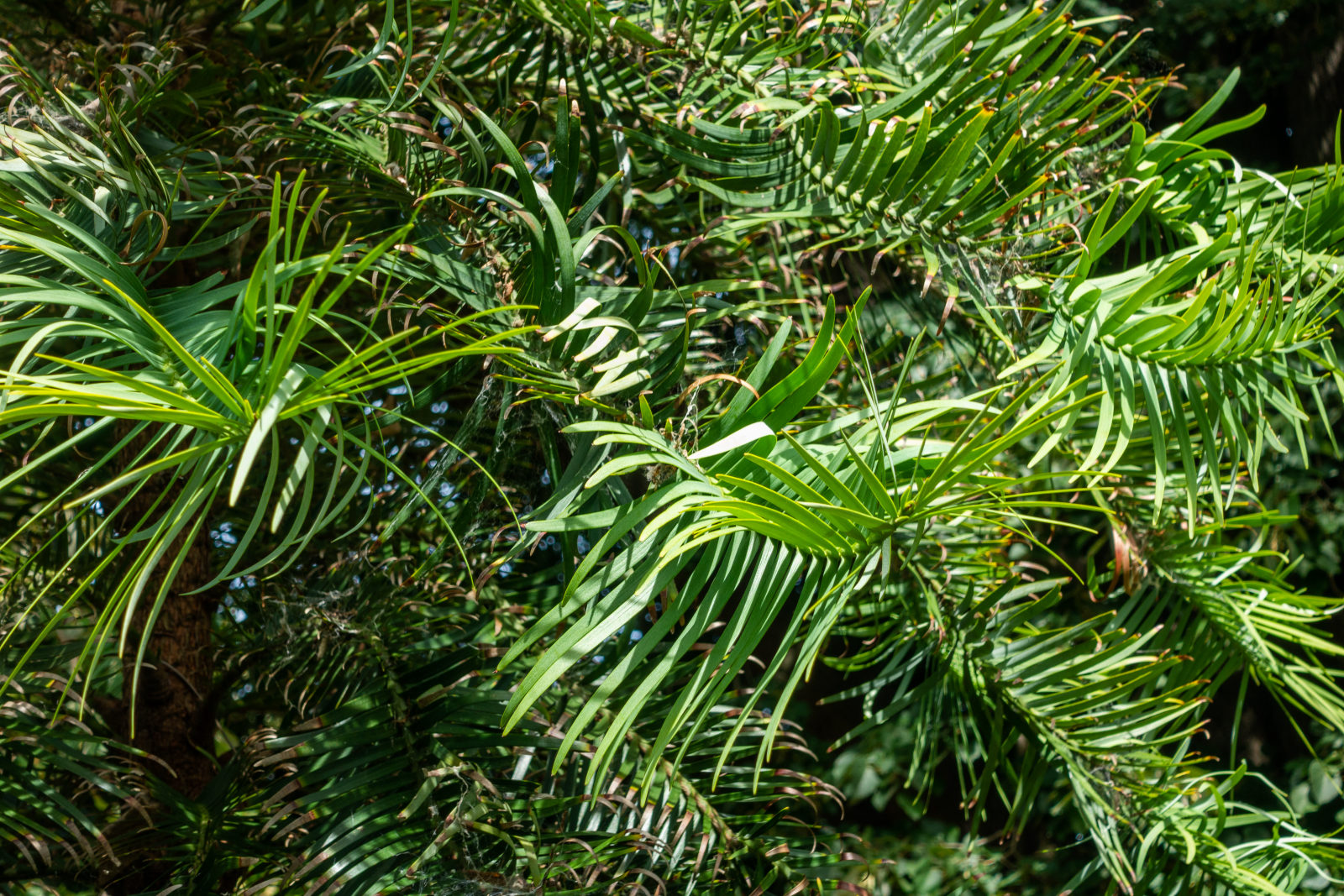
Wollemia nobilis A mature specimen at Christchurch Botanic Gardens, New Zealand. The wild population in Australia is kept secret; ex-situ trees like this one have been planted in botanical gardens worldwide since the species' rediscovery in 1994 as an insurance policy against extinction. Photograph: Michal Klajban, January 2022 · CC BY-SA 4.0 · sourced from Wikimedia Commons.
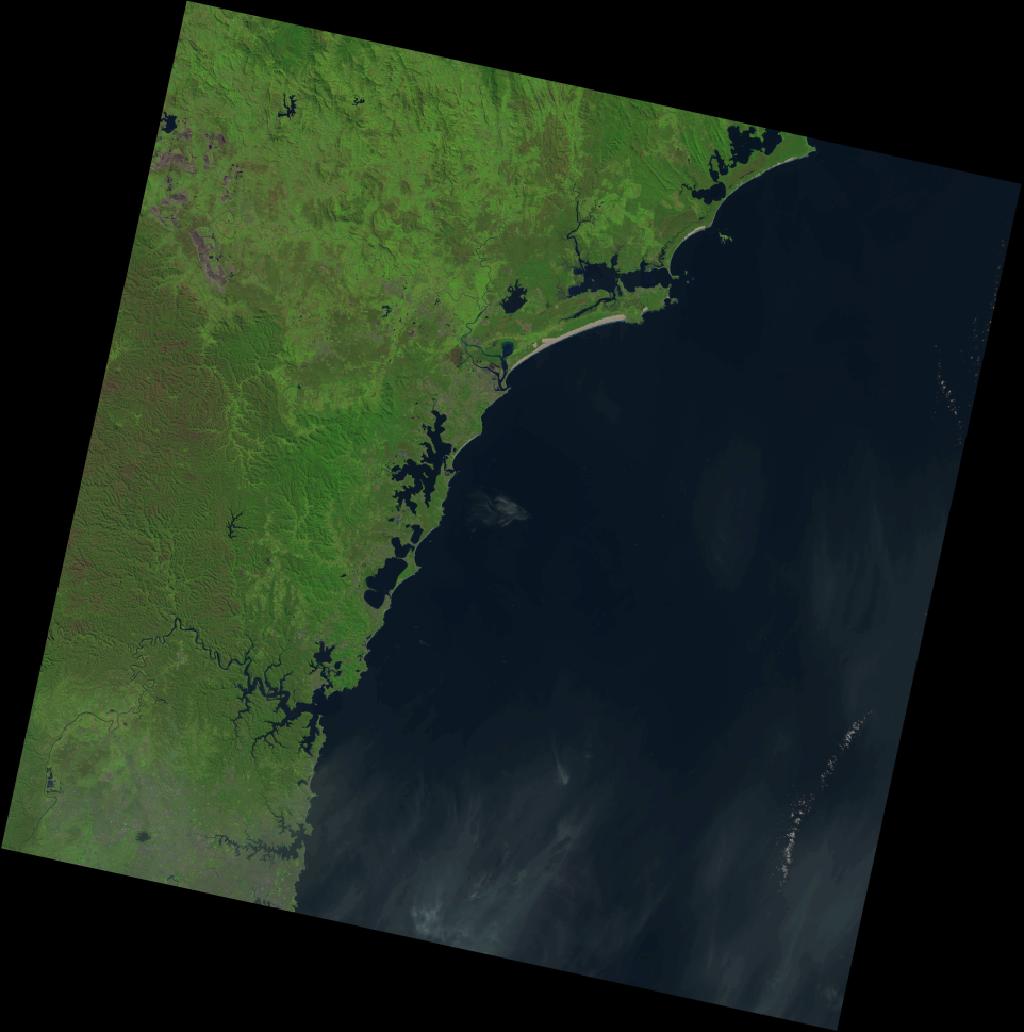
2 August 2019 — Before The Greater Blue Mountains World Heritage Area, photographed from Landsat 8 four hundred and ninety kilometres above the Pacific coast. The dark green forest in the centre-left of the frame is Wollemi National Park. Somewhere inside it — its precise location kept secret — is a canyon where fewer than fifty adult Wollemi Pines have lived for 90 million years.
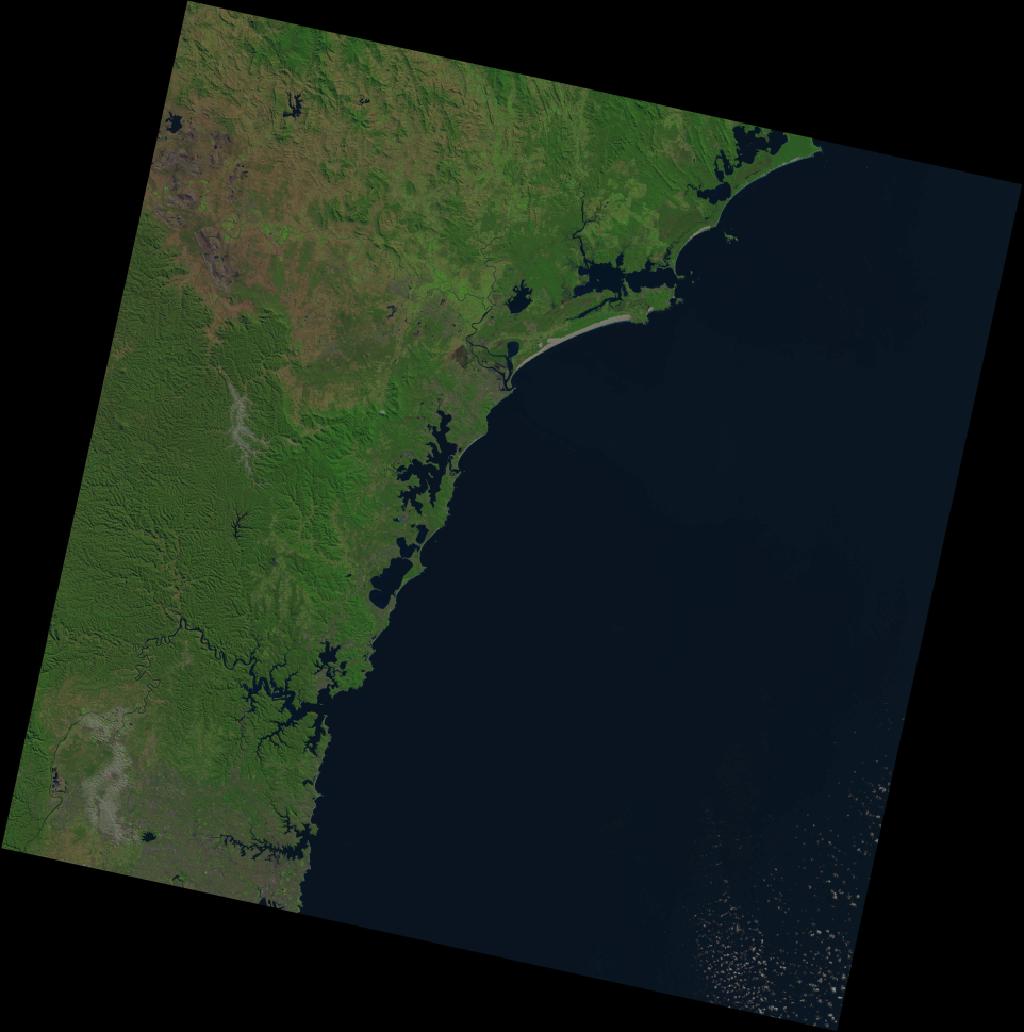
14 April 2020 — After Two months after the Gospers Mountain Fire was finally contained. The same Landsat satellite, the same orbital pass, the same coordinates. The pale, mottled brown across the interior is the burn scar — at the time, the largest single forest fire ever recorded in Australia. The trees in the canyon survived, saved by a covert firefighting operation. The forest around them did not.
Imagery: NASA / USGS · Landsat 8 OLI Collection 2 Level-2 · Path 089, Row 083 · same satellite, same orbital pass, eight months apart. Public domain. Sourced via USGS EarthExplorer.
Some plant locations in this series are shown at regional scale only. For species vulnerable to illegal collection, precise coordinates are deliberately not published — a practice followed by Oya and by the conservation custodians who shared the original research. Knowing where, in general, is enough to tell the story. Knowing exactly where would put the species at risk.
Wollemia nobilis
For 90 million years Wollemia nobilis survived the dinosaurs, three mass extinctions, and the slow cooling of the southern continents. Then, in the spring of 2019, a megafire bore down on the single canyon where fewer than fifty mature trees stood — and the only thing between the species and oblivion was a small team of NSW park rangers, flown in by helicopter, who had been quietly preparing for exactly this moment for two decades.
Quick facts
- Family
- Araucariaceae — the ancient southern conifer family, related to the Norfolk Island Pine and the Monkey Puzzle
- Discovered to science
- 1994, by David Noble, a New South Wales Parks ranger canyoning in his spare time
- Evolutionary age
- The genus appears in the fossil record at least 90 million years ago, last seen in the rock before the asteroid impact that ended the Cretaceous
- IUCN status
- Critically Endangered — IUCN Red List, 2024 · population: 46 mature individuals (2020 census); the 2024 assessment is the most recent formal evaluation
- Wild population
- 89 individuals in total at the most recent (2020) census — 46 mature trees and 43 juveniles — all in a single sandstone canyon in Wollemi National Park, north-west of Sydney
- Habitat
- A deep, wet sandstone gorge at approximately 600 m elevation, sheltered from sun and frost — a microclimate that has changed remarkably little in tens of millions of years
- Habitat protection
- Greater Blue Mountains UNESCO World Heritage Area (inscribed 2000); the precise canyon location is withheld by NSW National Parks and Wildlife Service
- Insurance population
- Cultivated specimens distributed to botanical gardens around the world since 1995. In 2023, formalised as the Wollemi Pine Metacollection Project — coordinated by Botanic Gardens Conservation International with the Botanic Gardens of Sydney — under which around 34 botanic gardens (28 across Europe, five in Australia and one in the USA) each hold a "six-pack" of specimens representing the full current genetic diversity of the species. The Conservatoire et Jardin botaniques de Genève received its six specimens in 2023.
- Primary threats today
- Climate-driven megafires; Phytophthora cinnamomi, a fungal root-rot pathogen carried in on the boots of unauthorised visitors
A tree thought extinct for ninety million years
In September 1994, a New South Wales park ranger named David Noble was canyoning in a remote part of Wollemi National Park when he came across a stand of trees he didn't recognise. He took a single branch home. The branch turned out to belong to a genus known previously only from fossils — last seen in the rock record approximately 90 million years ago.
Fewer than fifty mature Wollemi Pines stood in that canyon. They had been there, undisturbed, since before the asteroid that killed the dinosaurs. The precise location was placed under lifelong secrecy.
A different kind of defence
Two decades before the helicopters, a different kind of defence was already in place.
In the years after the 1994 discovery, the New South Wales National Parks and Wildlife Service and the Royal Botanic Garden, Sydney made an unusual choice. Faced with a species so rare its precise location had to be secret, the conventional move was to restrict and protect. They did the opposite — they propagated the tree at scale and released it to the world.
The first cultivated Wollemi Pine was planted in Sydney in 1998. Commercial release followed in 2005. Within a decade, Wollemi Pines were growing in gardens from Hawaii to Moscow. The reasoning was simple: a species growing in thousands of gardens cannot easily be lost.
In 2023 the strategy formalised into the Wollemi Pine Metacollection Project, coordinated by Botanic Gardens Conservation International with the Botanic Gardens of Sydney. Genomic analysis had revealed distinct genetic strains earlier surveys had missed. Each participating garden now receives a "six-pack" of specimens chosen to represent the full current genetic diversity of the species. Around 34 botanic gardens (28 across Europe, five in Australia and one in the USA) hold fragments of this distributed ark, including the Conservatoire et Jardin botaniques de Genève, which received its six specimens in 2023.
By the time the fire approached the canyon in December 2019, the Wollemi Pine had — quietly — already been saved. Not in the place it had survived for 90 million years, but in a global archipelago of gardens, each one a fragment of an insurance policy written two decades earlier.
A tree in a botanical garden is preserved, not evolving. The metacollection holds the genes. The canyon holds the species. The conservation of the Wollemi Pine is not one story but two: the dramatic rescue, and the quiet distribution that began in 1995.
The summer Australia called Black
In late 2019, a fire that began at Gospers Mountain spread through the Wollemi sandstone country and became, by the time it was finally contained in February 2020, the largest single forest fire in Australian history. It burned roughly half a million hectares.
As the firefront approached the Wollemi Pine canyon in mid-December, the New South Wales National Parks and Wildlife Service launched an operation it had been quietly preparing for years. Specialist firefighters were inserted by helicopter into the canyon. Sprinklers were rigged into the canopy. Water bombers laid fire retardant on the surrounding ridges. The location remained secret throughout.
By the time the fire passed, every previously known mature Wollemi Pine was still standing.
Saved this time
The 2019–20 Black Summer fires killed an estimated three billion vertebrate animals and burned approximately twenty per cent of Australia's temperate forests. The Wollemi Pines survived because a small team of public servants had been planning for exactly this moment for years.
What climate science makes clear is that a megafire of this scale is no longer a once-in-a-century event. The next one is coming — and it will come into a hotter, drier landscape. The Wollemi Pine survived 2019–20 because someone reached the canyon in time. The question for the next generation of conservationists is whether that will keep being possible.
Timeline
- September 1994David Noble, a New South Wales park ranger, finds a stand of unidentified trees while canyoning in a remote part of Wollemi National Park
- 1995 onwardsWollemi Pine propagated and distributed to botanical gardens worldwide as an insurance population
- 1998Royal Botanic Garden Sydney begins the Wollemi Pine Recovery Plan
- 2000Greater Blue Mountains inscribed as a UNESCO World Heritage Area
- 2011IUCN Red List assesses Wollemia nobilis as Critically Endangered; population estimated at fewer than 100 mature individuals
- Late 2019Gospers Mountain fire ignites; spreads through the Wollemi sandstone country during the Black Summer fire season
- Mid-December 2019NSW National Parks and Wildlife Service launches "Operation Wollemi" — specialist firefighters inserted by helicopter, sprinklers rigged into the canopy, retardant laid on the surrounding ridges
- February 2020Fires contained; every previously known mature Wollemi Pine still standing
- 2023Conservatoire et Jardin botaniques de Genève receives six specimens representing the full current genetic diversity of the species
- October 2023Wollemi Pine Metacollection — the first global metacollection — launched at Bedgebury (UK) by Botanic Gardens Conservation International and the Botanic Gardens of Sydney; around 34 botanical gardens across Europe, Australia and the USA participate
Key statistics
Sources and citations 6 references ›
- Auld, T.D. & Mackenzie, B.D.E. (2024). Wollemia nobilis. The IUCN Red List of Threatened Species 2024: e.T34926A150329250. Wild population: 46 mature individuals (89 in total at the 2020 census). iucnredlist.org/species/34926/150329250
- NSW National Parks and Wildlife Service (2020). "Operation Wollemi: a covert firefighting mission to save the world's last wild dinosaur tree."
- Royal Botanic Garden Sydney. Wollemi Pine Recovery Plan (1998 onwards).
- van Oldenborgh, G.J., et al. (2021). "Attribution of the Australian bushfire risk to anthropogenic climate change." Natural Hazards and Earth System Sciences.
- NSW Department of Planning, Industry and Environment. 2019–20 Bushfire Season Report.
- NASA Earth Observatory / NASA Worldview. MODIS Terra Corrected Reflectance imagery, September 2019 and January 2020.