
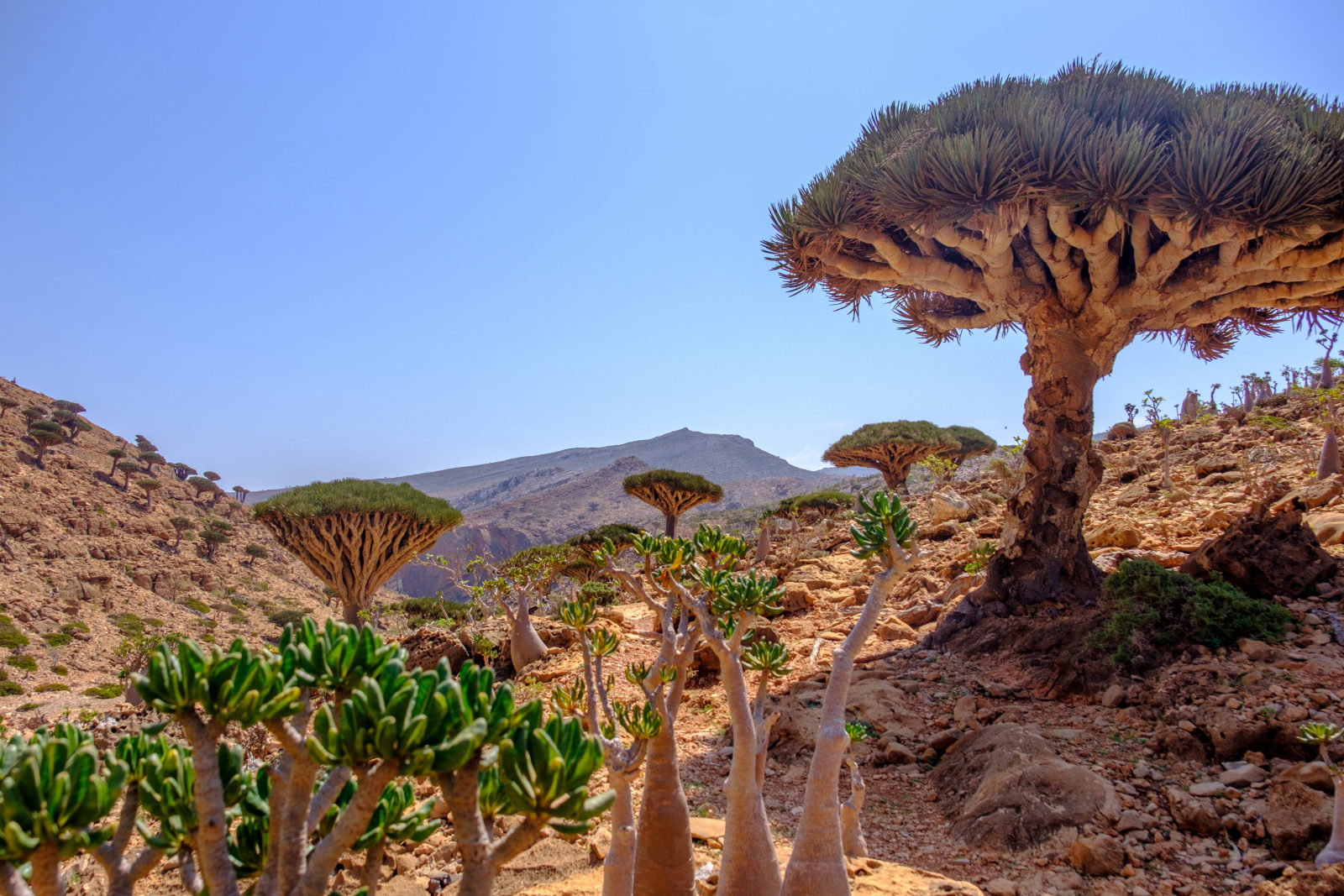
Dracaena cinnabari Mature Dragon Blood Trees on the Homhil Plateau, central Socotra. The umbrella canopy is the species' adaptation to capturing mist from the clouds that drift inland from the Arabian Sea each morning — moisture that otherwise the island's granite peaks would not hold. Photograph: Hardscarf, October 2023 · CC BY-SA 4.0 · sourced from Wikimedia Commons.
Eleven days separate these two satellite views. On the left, Socotra in calm. On the right, the storm that struck the island in the early hours of 1 November 2015 — the first Category 4 cyclone ever recorded to make landfall in Yemen.
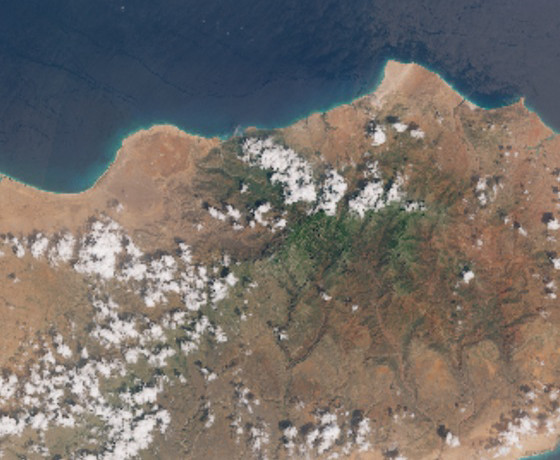 22 October 2015
Socotra · before
22 October 2015
Socotra · before
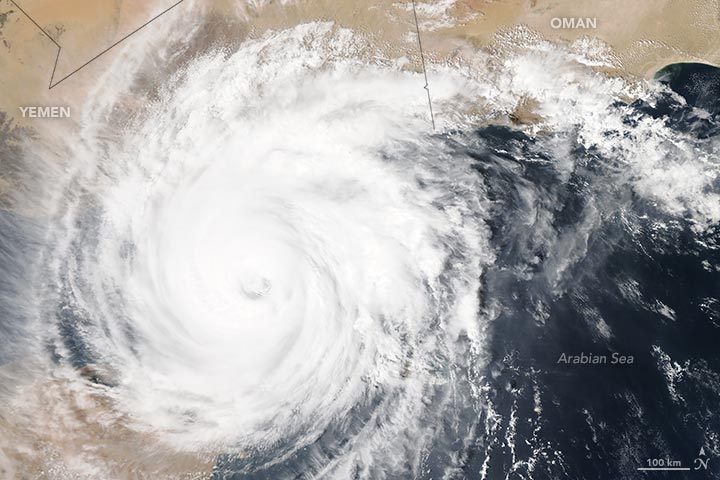 2 November 2015
Cyclone Chapala · the day before landfall
2 November 2015
Cyclone Chapala · the day before landfall
22 October 2015 — Socotra at peace Ten days before Cyclone Chapala. The Hajhir Mountains in the central east — the heart of the Dragon Blood Tree's range — carry their intact green cover. ESA's Sentinel-2A captures this at ten-metre resolution, eighteen times sharper than the older Landsat archive. Roughly sixty thousand Soqotri pastoralists are at home. The conservation programme is still running.
2 November 2015 — over the Arabian Sea NASA's Aqua satellite catches Cyclone Chapala at peak strength in the Arabian Sea, with its eye clearly visible. The storm had already passed directly over Socotra a day earlier on 1 November — battering the island with sustained winds of 105 knots, the first Category 4 cyclone Yemen had ever recorded. Socotra sits roughly 200 km south of this frame.
Imagery — 22 October 2015: ESA Copernicus · Sentinel-2A MSI Level-1C · 10 m resolution. 2 November 2015: NASA Earth Observatory image by Jeff Schmaltz, LANCE/EOSDIS Rapid Response · MODIS aboard NASA's Aqua satellite. Both public domain. Sourced via ESA Copernicus Data Space Browser and NASA Earth Observatory.
Dracaena cinnabari
Dracaena cinnabari is the most recognised image of Socotra — an umbrella-shaped tree that may live for more than six hundred years and bleeds a crimson resin when cut. It grows nowhere else on Earth. The species is not, yet, Critically Endangered. Its problem is more patient than that: most of the trees you see in photographs are centuries old, the seedlings that do germinate are mostly eaten by introduced goats, and the cyclones that once arrived once a generation are arriving more often. The species is being out-lasted by a slowly changing world.
Quick facts
- Family
- Asparagaceae — once placed in its own Dracaenaceae family, now grouped with asparagus, agave and yuccas
- Described to science
- 1882, by Isaac Bayley Balfour at Edinburgh, from material collected on Socotra in 1880
- IUCN status
- Vulnerable (assessed 2004); ageing population with little functional regeneration
- Wild population
- Approximately 80,000 individuals island-wide (UAV survey, Hubálková et al. 2023); the IUCN 2004 figure of 5,000 – 7,000 referred to mature trees on the Haggeher plateau and remains the conservation benchmark
- Habitat
- Granite mountain slopes and plateaux of central Socotra, principally the Hajhir (Haggeher) range up to ~1,500 m, where morning fog from the Arabian Sea provides the moisture that distinguishes the island's interior from its coast
- Habitat protection
- Socotra Archipelago UNESCO World Heritage Site (inscribed 2008); a Yemeni protected-area network exists on paper but has been disrupted by the war
- Insurance population
- Cultivated specimens at the Royal Botanic Garden Edinburgh, Royal Botanic Gardens Kew and a small number of arboreta in the Canary Islands, the United Arab Emirates and the United States
- What touched it
- The Yemen civil war (2015 – present); Cyclones Chapala (1 Nov 2015, Category 4) and Megh (8 Nov 2015), the first major cyclones to strike Socotra in recorded history; introduced grazing by goats; climate-driven drought stress
- Primary threat today
- The combination of more frequent Arabian Sea cyclones, drought-reduced seedling survival, browsing by introduced livestock, and the slow attrition of a conservation programme that depended on a functioning Yemeni state
An island that evolution forgot to finish
Socotra Island drifted from Africa around six million years ago and never reconnected. In that isolation, evolution went its own way. Of about 825 plant species recorded on the island, more than a third are found nowhere else in the world — frankincense and myrrh trees, cucumber trees with bottle-shaped trunks, and the iconic Dragon Blood Tree with its umbrella canopy and crimson sap.
Roughly 60,000 Soqotri people have lived on the island for thousands of years, traditionally as pastoralists and fishermen. The Dragon Blood Tree appears in Soqotri proverbs and medicinal traditions. In 2008, UNESCO inscribed the Socotra Archipelago as a World Heritage Site, recognising its global importance. Conservation programmes, research stations, and tourism began to grow. The island, although remote and poor, seemed to have a future.
Two storms in one week
In 2014, Houthi forces took Sana'a, Yemen's capital. In March 2015 a Saudi-led coalition began military operations against them. The war that followed devastated mainland Yemen and disrupted everything that depended on a functioning state — including the Socotra conservation programme.
Then, in November 2015, two consecutive tropical cyclones struck Socotra within a week of each other. Chapala made landfall as a Category 4 storm on 1 November; Megh hit on 8 November. Together they damaged thousands of trees, killed livestock, displaced families, and destroyed much of the island's already fragile infrastructure.
The Dragon Blood Trees, slow-growing and shallow-rooted, are particularly vulnerable to violent winds. Approximately 30 per cent of the island's vegetation was destroyed or stripped. The conservation organisations who would have responded were stretched thin or absent.
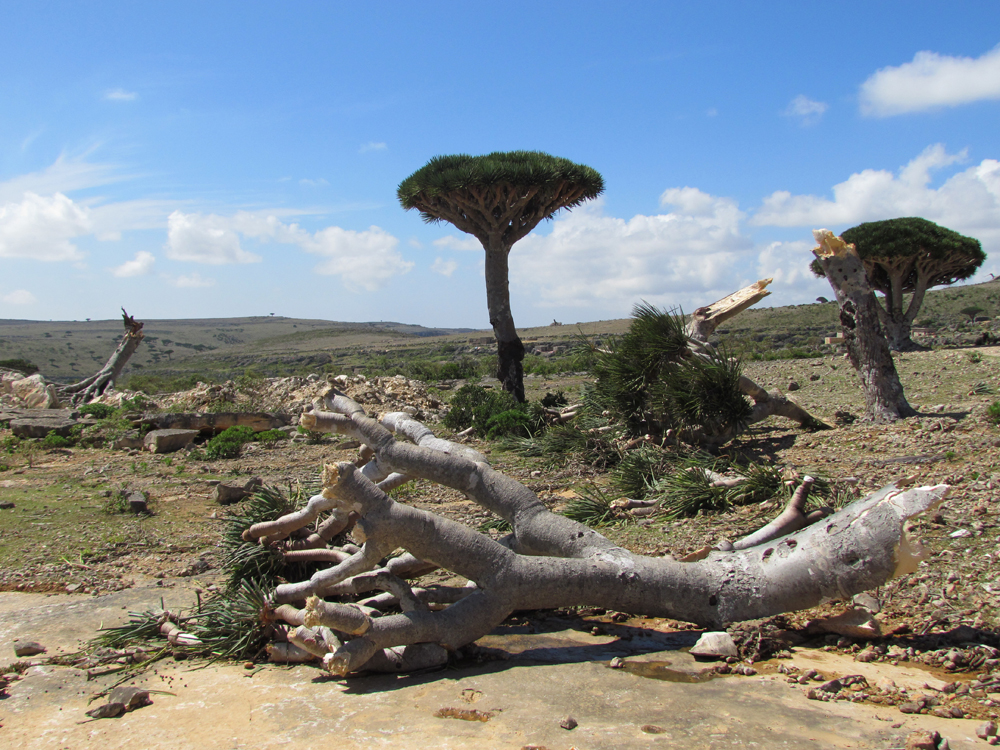 © IUCN / Ismail Mohammed
A future without seedlings
A decade on, Socotra has been pulled into the broader Yemen war. The United Arab Emirates established a military presence on the island in 2018; in 2020, Southern Transitional Council forces took political control. The Dragon Blood Trees still stand — but their world is harder.
Climate change is increasing the frequency of tropical cyclones in the Arabian Sea. Drought stress reduces seedling survival. Introduced goats and other livestock browse the seedlings that do germinate, meaning few young trees mature.
The species is not yet Endangered — it is Vulnerable — but its population is ageing. Many of the trees you see in photographs are centuries old. Their descendants are not coming through. Conservation work has slowly resumed; what shape it can take in the years ahead depends largely on whether the war ever fully ends.
Timeline
- 1882Dracaena cinnabari formally described to science by Isaac Bayley Balfour at Edinburgh
- 2008Socotra Archipelago inscribed as a UNESCO World Heritage Site
- 2014Houthi forces take Sana'a, beginning the Yemen civil war
- March 2015Saudi-led coalition begins military operations in Yemen
- 1 – 3 Nov 2015Cyclone Chapala makes landfall on Socotra as a Category 4 storm
- 8 – 9 Nov 2015Cyclone Megh follows, hitting the island a week later
- 2018UAE establishes a military presence on Socotra
- 2020Southern Transitional Council takes political control of the island
- 2023UAV survey (Hubálková et al.) maps approximately 80,000 mature trees island-wide
Incidents on the map
| Date | Place | Description | Source |
|---|---|---|---|
| 2014 | Sana'a (15.36°N, 44.21°E) | Houthi takeover; broader Yemen war begins | UN OCHA |
| 1 – 3 Nov 2015 | Northern Socotra (12.59°N, 54.10°E) | Cyclone Chapala landfall | NASA / WMO |
| 8 – 9 Nov 2015 | Socotra (whole island) | Cyclone Megh follows Chapala | NASA / WMO |
| 2018 | Hadibo (12.65°N, 54.02°E) | UAE establishes military presence | Yemeni government statements |
| 2020+ | Socotra Archipelago | Political control shifts to Southern Transitional Council | International press |
Key statistics
Sources and citations 8 references ›
- IUCN Red List (2004). Dracaena cinnabari species assessment.
- Hubálková, H., et al. (2023). UAV survey of Dragon Blood Tree population on Socotra. MDPI Forests, 14(4), 840. DOI: 10.3390/f14040840.
- Habrová, H., et al. (2009 – 2018). Multiple papers on the Dragon Blood Tree populations of Socotra. Mendel University in Brno.
- Royal Botanic Garden Edinburgh. Socotra Flora research programmes.
- NASA Earth Observatory. Cyclone Chapala and Megh satellite analyses (November 2015).
- IUCN (2016). Photo gallery: Cyclones hit Yemen's remote Socotra Archipelago. Photographs by Ismail Mohammed documenting damage to Dragon Blood Trees and other endemic vegetation. iucn.org.
- UNESCO World Heritage Site documentation for the Socotra Archipelago.
- UN OCHA. Yemen humanitarian reports, 2014 – present.