Five illustrated chapters — anatomy, plant structure, photosynthesis, seeds and growth, and why plants matter — with accurate, clearly explained science at every step.
A flower is the part of a plant that makes new life. Its whole purpose is to produce seeds, so that one plant can give rise to many — and to do that, it has grown into one of the most beautifully organised structures in nature.
What looks like a simple ring of petals is, in fact, a precise arrangement of working parts: the flower's male and female organs at the centre, the petals that shelter and advertise them, and the slender tissues that carry water and food. Each part has a name and a job — and once you can name them, the whole flower starts to make sense.
The Oya illustration below shows a flower cut through the middle, so you can see every part at once — from the petals on the outside to the ovules at the very centre, each of which can one day become a seed. Select any term beneath the illustration to read what it is and what it does.
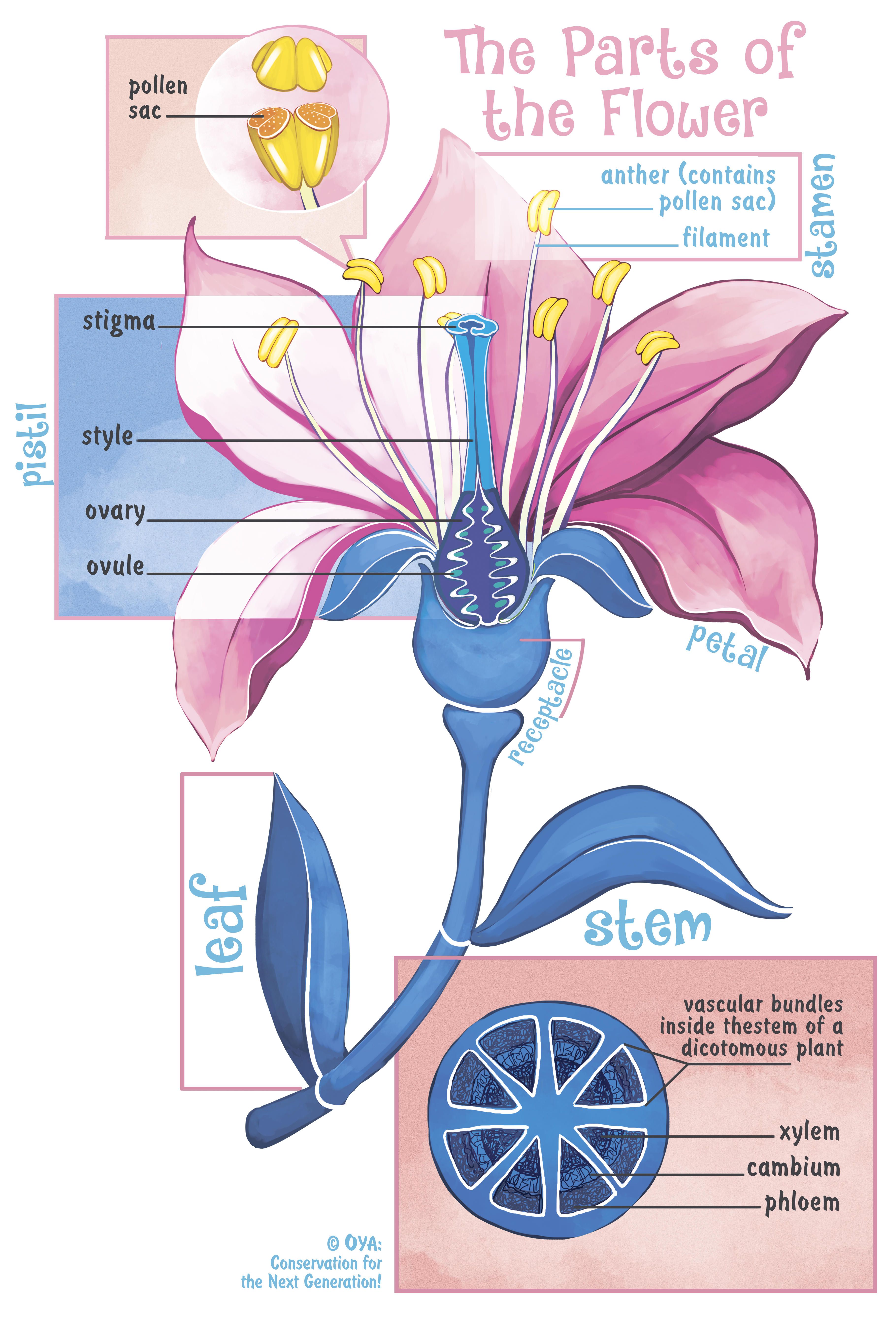
Select any term to read its botanical definition. Start with Petal, then work your way inward toward the centre of the flower.
Step back from the flower and you can see the whole plant — and it is just as carefully organised. A flowering plant is built in two halves. Above the ground is the shoot system — the stem, the leaves, the buds and the flowers. Below the ground is the root system, which holds the plant steady and draws up the water and minerals it needs to grow.
Every part has its own name and its own job. The Oya illustration below maps them all, from the flower at the very top of the shoot down to the fine branch roots deep in the soil. Knowing this layout is the first step to understanding how a plant grows, how it responds to its surroundings, and what happens to it when its home is disturbed. Select any term beneath the illustration to read what it is and what it does.
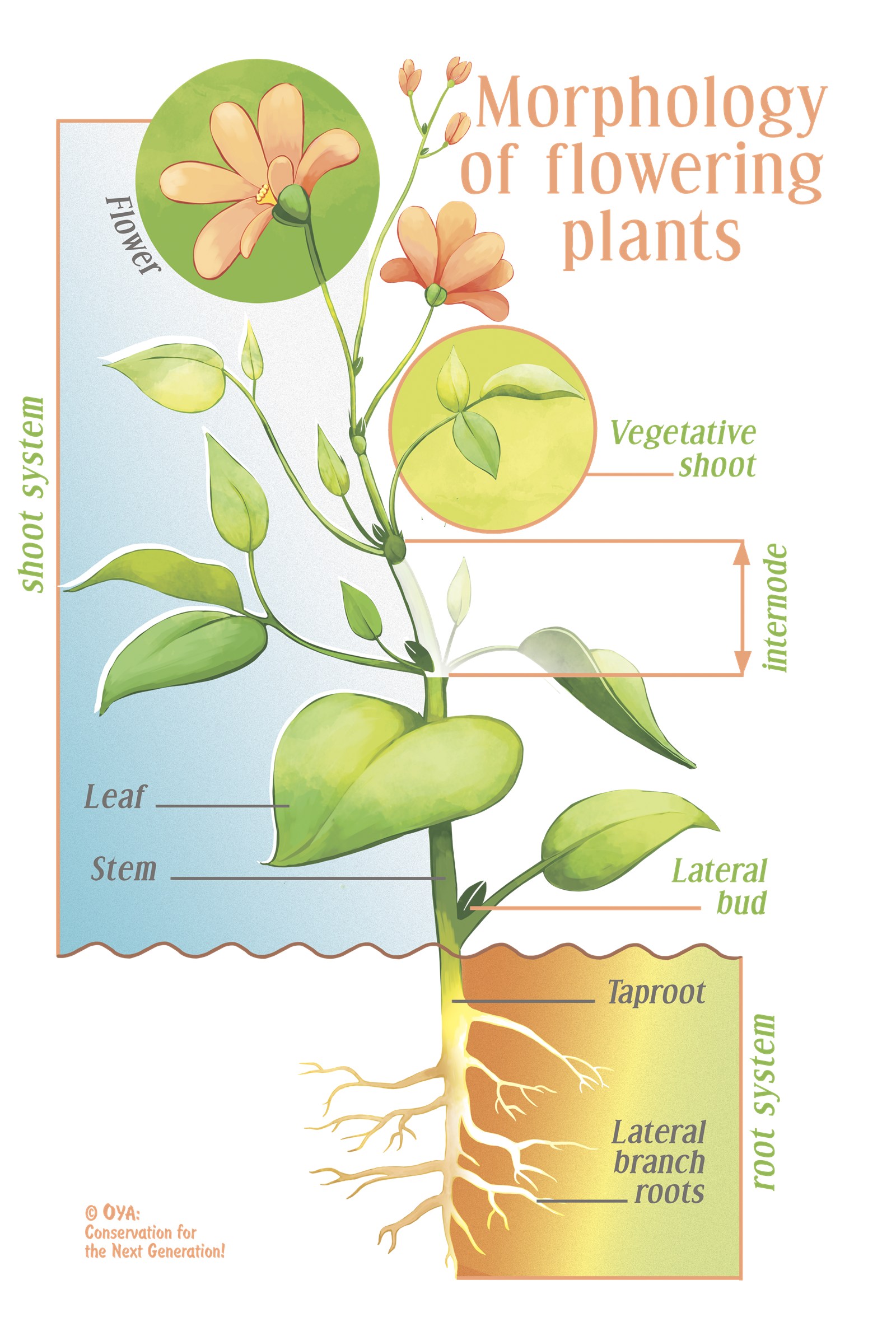
Select any term to read its botanical definition. Follow the plant from its flower at the top down through the stem and into the root system.
Now that you know what the leaf looks like and where it sits in the plant, you can understand what it does. Leaves are the primary site of photosynthesis (say: foh-toe-SIN-thuh-sis) — the process by which plants use energy from sunlight to convert simple raw materials into food.
The overall equation of photosynthesis
The leaf draws carbon dioxide from the air through microscopic pores called stomata. Water travels up from the roots through the xylem. Sunlight is captured by chlorophyll — the green pigment inside the leaf's cells. Using this energy, the leaf converts carbon dioxide and water into glucose, a sugar that feeds the entire plant. Oxygen is released as a by-product.
The oxygen released by photosynthesis is the oxygen in the air we breathe. Every breath we take depends on this process having occurred — in leaves, in algae, in the ocean's phytoplankton. This is why the loss of plant habitat directly threatens all life on Earth.
The glucose produced by photosynthesis is transported from the leaves to the rest of the plant via the phloem — the same tissue you encountered in the stem cross-section in Chapter 1. The plant uses glucose for energy, and also converts it into cellulose (for cell walls), starch (for storage), and other essential compounds.
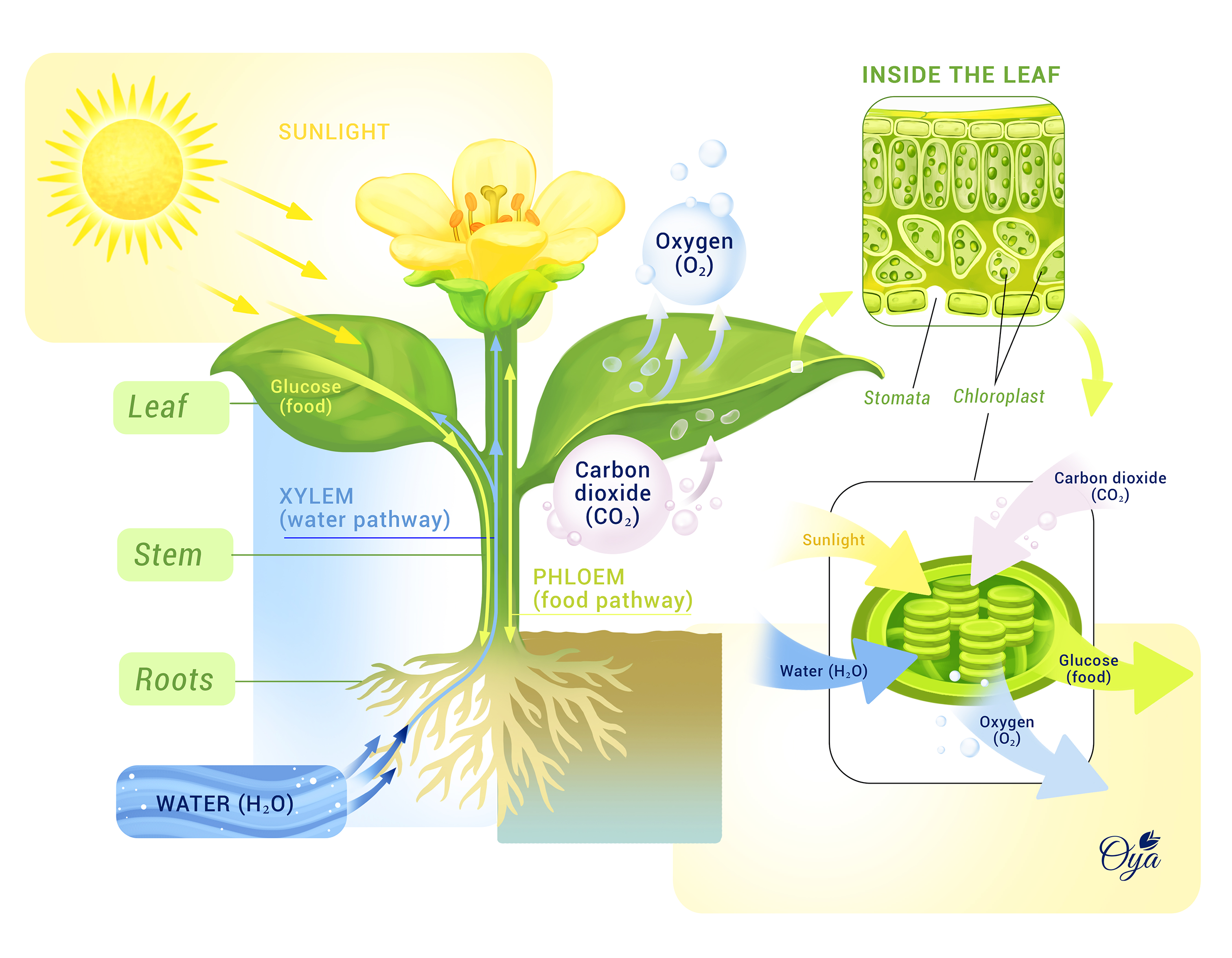
Select any term to read what it does in photosynthesis. Follow the leaf from what it takes in, to what happens inside it, to what it makes.
Every flowering plant you have met so far begins life as a seed — a small, self-contained package holding a tiny baby plant, a built-in food supply and a protective coat. A seed can wait, sometimes for years, until the conditions are right; then, in a process called germination, it wakes and begins to grow.
Inside every seed is a miniature plant, the embryo, already carrying its first root and first shoot. Around it is a store of food — rich in starch, oils and protein — that fuels the first burst of growth, before the young plant has any leaves of its own to make food by photosynthesis.
The Oya illustration below follows the whole journey: a flower is pollinated, its seeds form and scatter, and a new seed sprouts to begin again. Select any term beneath it to read what each stage means.
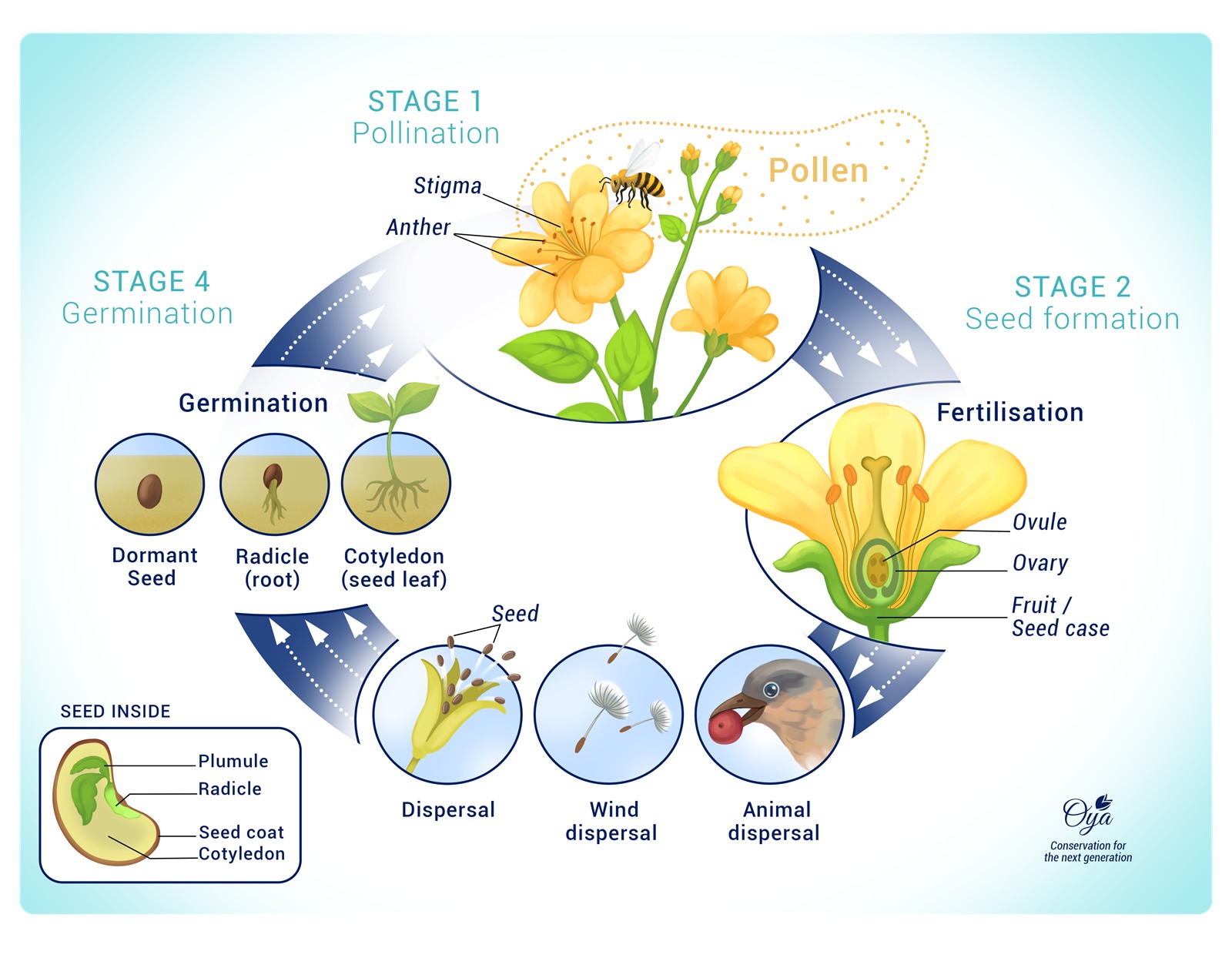
Select any term to read what it means. The terms follow the four stages shown in the illustration — pollination, seed formation, dispersal and germination — and end with a close-up of what lies inside a single seed.
Everything you have discovered in Chapters 1 to 4 points to one conclusion: plants are not just part of the natural world — they are its foundation. The same photosynthesis that feeds a single leaf is, multiplied across forests, grasslands, and oceans, what makes the whole planet liveable.
Plants release the oxygen we breathe and pull in carbon dioxide as they make their food. They sit at the bottom of almost every food chain — directly or indirectly, nearly everything we eat begins with a plant. Their roots hold soil in place and help clean and store water, while their leaves and stems give countless animals a place to live.
Many of the foods we love also depend on pollinators — the bees, butterflies, birds, and bats that carry pollen from flower to flower. Around three-quarters of the world's food crops do better when animal pollinators visit them, and pollinators in turn depend on healthy flowering plants. Lose one, and you put the other at risk.
Plants are also part of how the planet manages its climate. As they grow, they lock away carbon in their leaves, wood, and roots, helping to balance the gases in the atmosphere. Forests, peatlands, and seagrass meadows are some of Earth's greatest stores of carbon.
This is why protecting plants matters. When a habitat is cleared or a species is lost, we do not just lose a single plant — we lose the food, shelter, clean air, and stable climate that depended on it. Oya believes that understanding is the first form of protection: when you can name what you are looking at and see how it all fits together, you start to care for the living world differently. The Oya illustration below shows just how much depends on plants.
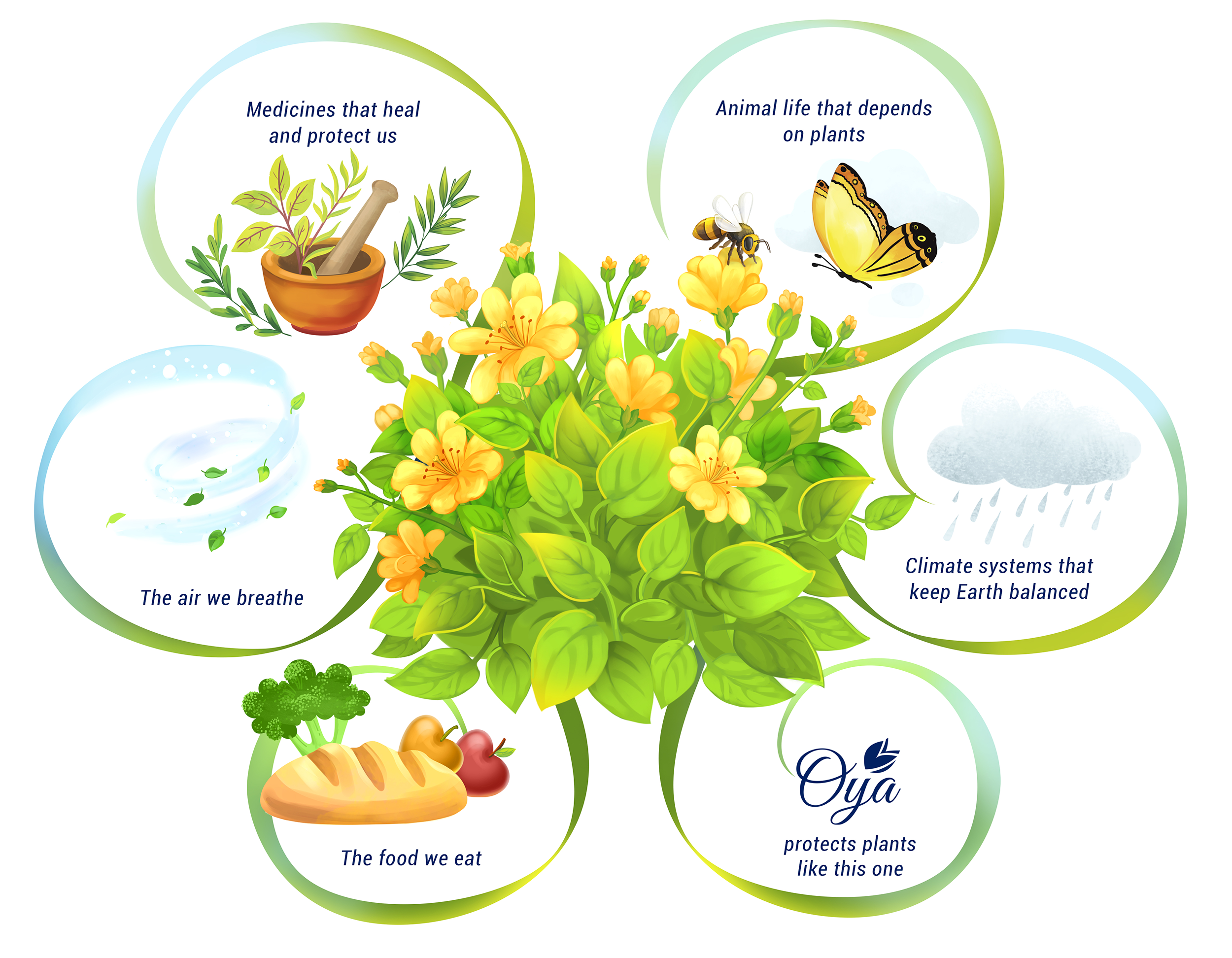
Select any term to read its description. These are the big ideas that connect a single plant to the health of the whole planet.
It begins with a seed — small enough to rest in the palm of your hand, and patient enough to wait. Inside its tough coat lies a tiny plant, already formed, curled around a store of food, waiting for the day the soil turns warm and damp.
When that day comes, the seed wakes. A root pushes down into the dark to anchor the new plant and drink up water, while a shoot reaches upward toward the light. The little plant has begun to grow.
Soon it stands as a whole plant — roots spreading below ground, a stem rising above, leaves opening to the sun. Every part has its work: the roots gather water, the stem carries it upward, and the leaves spread wide to catch the light.
And in those leaves, something quietly astonishing happens. Using only sunlight, air and water, the leaf makes its own food — a sugar called glucose — and releases the oxygen that fills our air. Every green leaf on Earth is doing this at once; much of the air you are breathing right now was made by living things like this one.
Fed by its leaves, the plant grows strong enough to flower. The flower is how it makes the next generation: bright petals to call a passing bee, pollen to travel from bloom to bloom, and deep inside, ovules waiting to become seeds. When a pollinator visits, the circle starts to close.
The flower fades, and a fruit swells in its place, holding new seeds. Wind, water or a passing animal carries them off to find soil of their own — and one of them, one day, will wait in the dark for the warmth, and begin again.
This is the story of one plant. Multiply it across forests, grasslands and oceans, and it becomes the story of the living Earth — the air we breathe, the food we eat, the climate held steady, the whole web of life resting, in the end, on a leaf and a seed. To understand a plant is to begin to care for all of it.
The plant structures you have explored here are not just biology — they are the foundation of ecosystems. Roots hold soil together. Leaves regulate the atmosphere. Flowers sustain pollinators. Seeds carry the future of species.
Right now, around 2 in 5 of the world's plant species are estimated to be threatened with extinction — most of them before science has even fully described them. Habitat loss, climate change, invasive species, and over-collection are the primary drivers.
Oya believes that understanding is the first form of protection. When you can name what you are looking at — when you know that the pistil contains ovules that will become seeds, or that the lateral branch roots are drawing water from a soil that may be drying — you see the living world differently.